News
The Best Movies About Playing Piano
March 28, 2026

The piano is one of the most popular instruments in the world, so it’s no surprise that there are so many movies about it. The world of cinema has captured a wide range of piano stories, from upbeat musicals and comedies to heartbreaking dramas and even tense thrillers.
We here at MuseFlow want to see what we can we learn from these movies about our own musical journeys. So let’s dive in and see what Hollywood has to say about playing the piano!

This critically acclaimed period drama tells the story of an imagined rivalry between the uptight, popular, and mediocre composer Antonio Salieri (F. Murray Abraham) and brash, irreverent, and brilliant virtuoso Wolfgang Amadeus Mozart (Tom Hulce).
The movie not only scooped up 8 Oscars, but also brilliantly captured the jealousy that can occur when you work really hard at your craft and then see someone who seems to be so much more successful and making it look so easy! We’ve all been there. But learning to shift our focus towards our own work is much healthier than doing what Salieri did (going down a lifelong spiral of sabotage and revenge)!

It’s hard to think about piano movies and not hear the catchy opening melody of “Another Day of Sun.” The musical tells the story of aspiring actress Mia (Emma Stone) and struggling pianist Seb (Ryan Gosling) as they encounter the conflicts of pursuing love and career in the “City of Stars.” La La Land is a bright, wondrous love letter to jazz and Hollywood that romanticizes show business while also reminding us of its ability to break hearts.
Like Seb, many piano players know what its like to feel stuck. We know how it feels to have to play songs we don’t like, whether that be through lessons or gigs. But at its core, La La Land is a movie about believing in yourself. There’ll be setbacks and self-doubt. But if you have a heart full of passion, maybe “that’ll be the thing to push you on and over.”

Ray tells the story of musician Ray Charles, detailing his life from his impoverished beginnings, struggles with blindness and heroin, and his career blending jazz, rhythm and blues, and gospel to create a brand new genre: soul.
Most people remember Ray for Jamie Foxx’s brilliant and charismatic portrayal of Ray Charles, which earned him the Oscar for Best Actor. But the most relatable thing about music biopics is the way they humanize these larger than life musicians. As we watch stars’ often humble beginnings and personal struggles, we see that these are human beings with flaws and insecurities.
It can be great to have musicians to look up to. But remembering that they’re all just human beings like you and me can help remind us that we’re all capable of greatness too!

Peanut butter and jelly. Cheese and crackers. Pixar movies and balling your eyes out. These things just go together…and Soul is no different. It tells the incredibly moving story of middle school teacher Joe Gardner (Jamie Foxx again), who falls down a manhole right before his big break, sending his soul into the Great Beyond. There he meets 22 (Tina Fey), a stubborn soul who is resistant to living life on Earth.
It’s easy to hang our self-worth on our creative/career success, but Soul director Pete Docter says to NPR, “we’re already enough…We all can walk out of the door and enjoy life without needing to accomplish or prove anything. And that’s really freeing.” You can reframe your musical passions as the things you do because you love them, not because you need to hit some arbitrary metric of success in order to have a “successful” life!

There are many more piano movies that we can’t even get to in this post. But when looking at all of these movies, a common message shines through. The best movies about piano aren’t about how to play the piano…they’re about why we play it.
Learning the piano can be wonderful, frustrating, stressful, and creatively fulfilling…sometimes all at the same time. But at the end of the day, your music journey is your own. Find your passion, be true to yourself, and stay grounded.
At MuseFlow, we know that learning the piano should be fun and meet you where you’re at. Our lessons:
So go watch one of these great piano movies, get inspired, and then come back and learn with us!

As we speak, the technology of artificial intelligence is making shockwaves in nearly every element of our lives; from dating, to work, to pet care…it can be difficult to get a grip on what exactly it is, and how it can (or can’t) benefit us. We here at MuseFlow saw the potential in AI to revolutionize music education and we have done just that. Keep reading to read more about how AI is revolutionizing music education.
MuseFlow approaches AI as a tool to support our sight-reading first philosophy, so that you can not only play songs you love on our app, but at a party with friends, at a concert or in your living room with a four-legged audience - wherever your musical aspirations take you. AI analyzes your progress and playing style to generate constantly new, progressively structured music. We focus on sight reading to make you an independently proficient player.
MuseFlow is certainly not the first piano app; how many have you downloaded before being met with rote memorization, boring jazz standards and plunky exercises? We combine our expert pedagogical philosophy with a meticulously designed curriculum, supported by AI to implement our approach adapted uniquely to you.
So far we’ve discussed how AI plays a part in the sight reading first philosophy and our adaptive learning approach. That’s just a preview into not only how AI supports our state-of-the-art features, but how we aim to improve the way you study music. Let’s dig a bit deeper.

MuseFlow uses AI in its unique adaptive learning structure, incorporating AI’s capability to accommodate a diverse range of learning styles and tailor instructions to where a learner currently is, whether they’re a beginner or a teacher brushing up on your skills.
As an example: let’s say, as you’re practicing, you’re really struggling with d7 chords but you intuitively pick up complex rhythms. MuseFlow will note that and continuously give you music phrases with that chord included until you’ve mastered it. It’s smoothly incorporated into your individualized practice, all while giving you real-time feedback.
What makes this different from a static method book or a one-size-fits-all curriculum is that MuseFlow’s AI is always listening and learning alongside you. It doesn’t just track right and wrong notes, it recognizes patterns in your playing over time. Maybe you tend to rush through fast passages, or you consistently hesitate before a key change. MuseFlow picks up on those nuances and adjusts your practice material accordingly, creating a feedback loop that keeps you growing without overwhelming you.

When you reach a point where something is perfect for you - not too challenging and not too boring - this is called the flow state. Learning feels effortless and time flies by. Some major elements of achieving flow state are balance between skills and difficulty, immediate feedback, and intrinsic motivation.
We make it easy to track your progress as you go and maintain control of your education. Practice feels like play. And when practice feels like play, you actually do it, on your own terms. That consistency is what separates the students who stick with piano for life from those who quit after a few months.
We prefer to think of MuseFlow as your personal AI tutor. We don’t believe the future of piano education is about replacing the very real human element in music education, but about building on a teacher's presence and giving students a leg up.
While MuseFlow handles the technical instruction, your teacher can carry you forward with the craft and musicianship. When you arrive at your lesson having already internalized the mechanics of a piece, your teacher is freed up to focus on the deeper artistry. Expression, dynamics, storytelling through music. That’s where the magic happens, and MuseFlow helps you get there faster.
We here at MuseFlow are passionate about music education and have worked hard to build an app that is not only revolutionary, unique, and effective, but one that honors the fun that inspired music learning in the first place. If you’re curious to see how AI can help your own journey, click below to try MuseFlow for free.
When you’re choosing a new instrument to learn, the choices can be daunting. There are literally thousands of instruments out there to choose from, but there’s nothing quite like the piano. That’s why we at MuseFlow offer a fun and effective way to learn this popular and enduring instrument. But what is it about the piano that makes it so important?
The piano is one of the most played instruments in the world. And a big part of that is its versatility across musical genres. The soothing classical music of Beethoven’s “Fur Elise.” The energetic jazz riffs of Duke Ellington’s “Take the ‘A’ Train.” The emotional modern pop bop of Chappell Roan’s “Pink Pony Club.” The piano is a core, foundational component of all of these musical genres, as well as many others (R&B, electronic, musical theater, film scores, Bossa Nova, and Tango to name a few). When you play each genre, you’re introduced to new tempos, melodies, and styles of play. The combinations and play styles are truly endless.
So when you’re learning the piano, you’re really opening yourself up to an entire world of music!
.avif)
Going along with its versatility, the piano is the perfect instrument for composers. That’s because you can play up to 12 notes at once, and it can act as a compression for entire orchestras, bands, and choirs. You can play the bass and rhythm with the left hand and melody and harmony with the right, with both hands operating at different registers, roles, and meters at the same time.
The piano is actually considered a percussion instrument that creates percussive, rhythmic, and immediate sounds when you press a key and the internal hammer strikes a string, or set of strings. But the sound created can also be a sustained pitch, which allows for lyrical, harmonic, and legato sounds. There’s no other instrument on Earth that can do all of this!
Before the invention of the piano, music composers needed access to entire ensembles to write songs. But since its invention, those ensembles have become available at composers’ fingertips. This makes composition more affordable and accessible. If you want to compose a song, all you need to begin is your piano!
Learning the piano can be a fun way to challenge your brain. One study found that learning the piano can enhance your fine motor skills, since it’s an instrument that requires strong finger dexterity. The way your brain has to compute the sight reading and playing simultaneously can also activate two different parts of your brain at the same time.
It’s no surprise, then, that another study suggested that learning the piano can boost brain processing power. After just a few weeks of lessons, the participants’ ability to process multi-sensory information had improved. Amazingly enough, those participants also reported an enhanced mood, with less anxiety, stress, and depression!
So the next time you’re practicing the piano, you can know that you’re basically doing crunches with your brain.
The piano is powerful. A somber chord in a movie soundtrack can bring us to tears. A springy tune at a wedding reception can send everyone, including that one uncle who never dances, running to the dance floor. A new song can stop us in our tracks. A recognizable melody can immediately pull us back to the first time we heard it. There’s an emotional resonance that we get from the piano that’s hard to put into words. But we know it when we feel it.
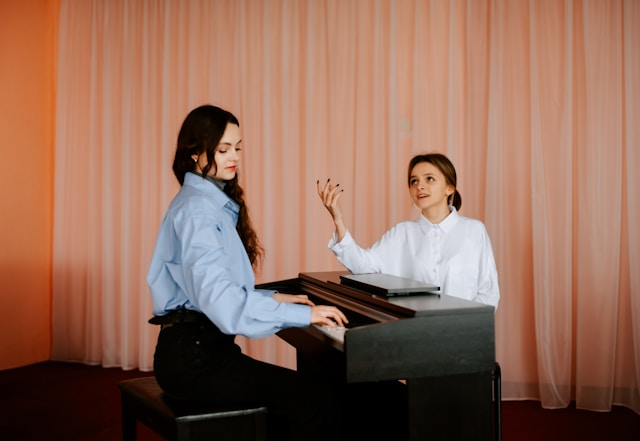
People have been playing this instrument since the 1700s. It’s been played for kings and queens. Its sound has filled massive stadiums of screaming fans as well as intimate living rooms with family and friends.
It’s an instrument unlike any other, able to stand in for just about any other instrument, even a full orchestra. You can play a limitless variety of music on those 88 keys. And since the piano doesn’t require size changes or “starter versions” like some other instruments, you can play a complex concerto on the same piano that you first learned “Ode to Joy” on.
The piano stands alone in its versatility, accessibility, and usefulness across musical genres. It’s a powerful and timeless instrument that has changed the worlds of music and composition forever. We’d say that makes it pretty darn important!

We here at MuseFlow know that there are as many different journeys to the piano bench as there are players - and just as many away from it, too. Below, we discuss the common reasons why people have trouble sticking with traditional music lessons and how the revolutionary app for learning piano MuseFlow challenges each one to help you learn to play, once and for all.
Traditionally, music is taught by a model of rote repetition with limited sight reading development. In fact, many other music apps teach you using this method. While it is entirely possible to learn this way, it takes much longer and can lead to burnout from boredom - especially in fast, intelligent learners. This can also lead to poor retention, slowing progress.
MuseFlow’s ingenious gamified interface makes learning feel like play, introducing music that never repeats to keep your brain engaged. Our adaptive learning adjusts to your skill level, allowing you to get into a Flow State while learning, promoting deep understanding in the quickest, most fun way possible. Studies show that fun is one of the most important factors for sticking with learning music.
The average music lesson in the United States in 2026 ranged from $280-$400 per month, not including access to music rooms throughout the week or purchasing books.
MuseFlow is a much more accessible piano learning option at $24.99 a month - including a free 14-day trial.

Especially if you initially played as a child, shifting priorities as we get older splits our focus and our time. Many little virtuosos had to choose between music and other extracurriculars.
MuseFlow helps you learn to play piano in your own time, even if that’s only 15 minutes a day; in your own space, even if that’s the kitchen table. The MIDI integration allows for support of various keyboard sizes.
Anyone who has ever lived in an apartment, or with someone picking up the recorder, understands the limits of learning a new instrument in almost any home environment.
MuseFlow’s MIDI keyboard interface allows you to not only learn to play anywhere you can set up the app, but with a pair of headphones, you can play in any environment.

When alone, it can be frustrating to practice repetitively without any indication whether you’re doing anything correctly or incorrectly. Especially when people are beginning to learn on their own, they can drop the practice due to this frustration. Even in classical piano training, with taking lessons once a week, practicing alone six days a week incorrectly reinforces bad habits.
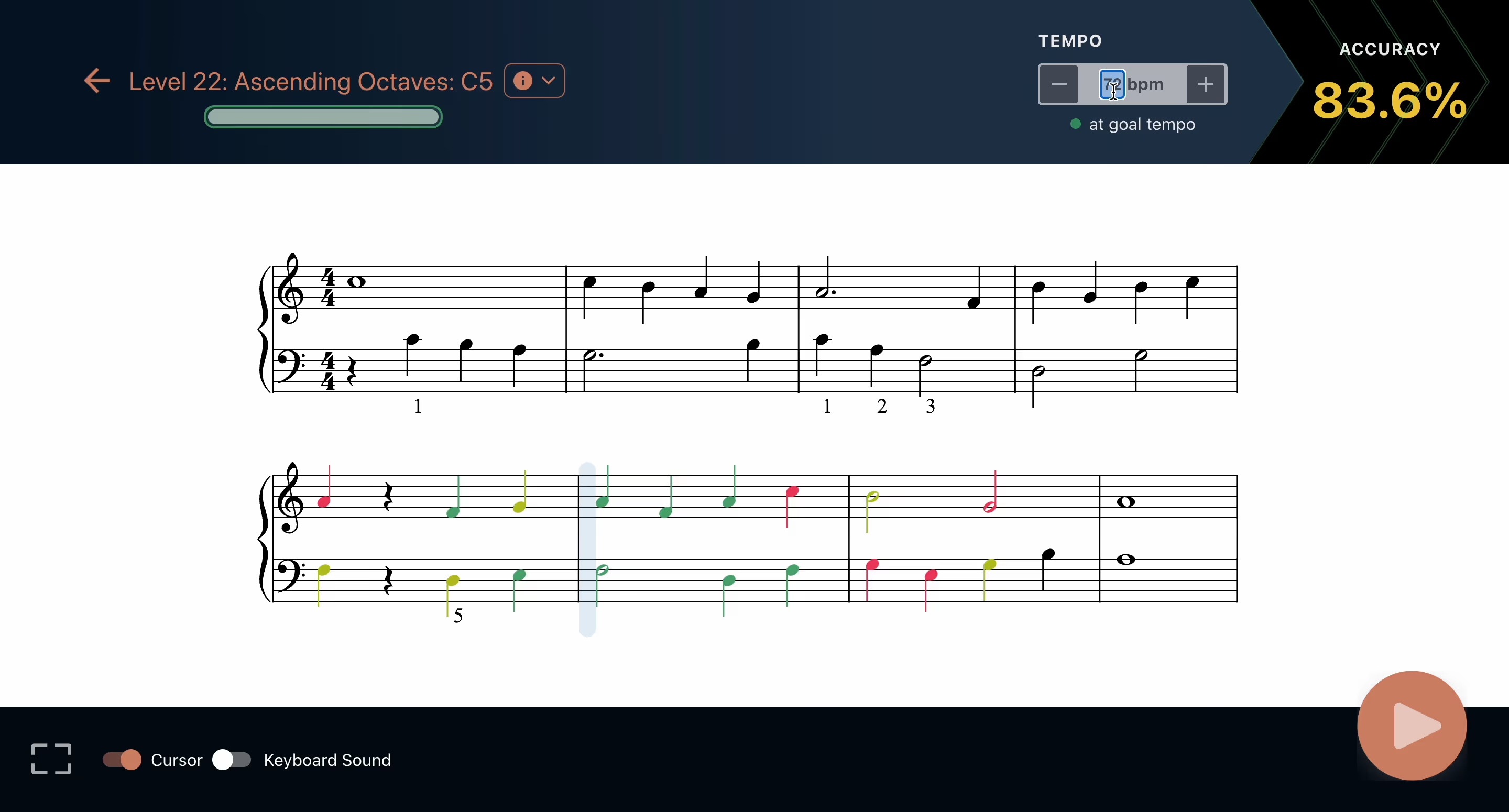
MuseFlow provides instant, precise feedback to gently help you correct mistakes in real-time, and instant audio and visual confirmation when you get it right. This is especially useful for complete beginners and self-taught pianists, so you can build confidence and a solid foundation. Seeing the fruits of your labor and success as you go is likely to increase self-confidence and empower you to keep up with your practice.
I get it - you want to get right to playing your favorite songs ASAP! The traditional method of rote memorization of the basics definitely has its value, but it does put a damper on your Elton John dreams. Progress can feel like a slog through inefficient exercises through traditional exercises.
MuseFlow’s sight reading first approach teaches you to read your favorite music fluently; not just the ones you’ve memorized, so you can get started once you’ve mastered each lesson. MuseFlow’s adaptive structure also allows you to progress at your own pace.
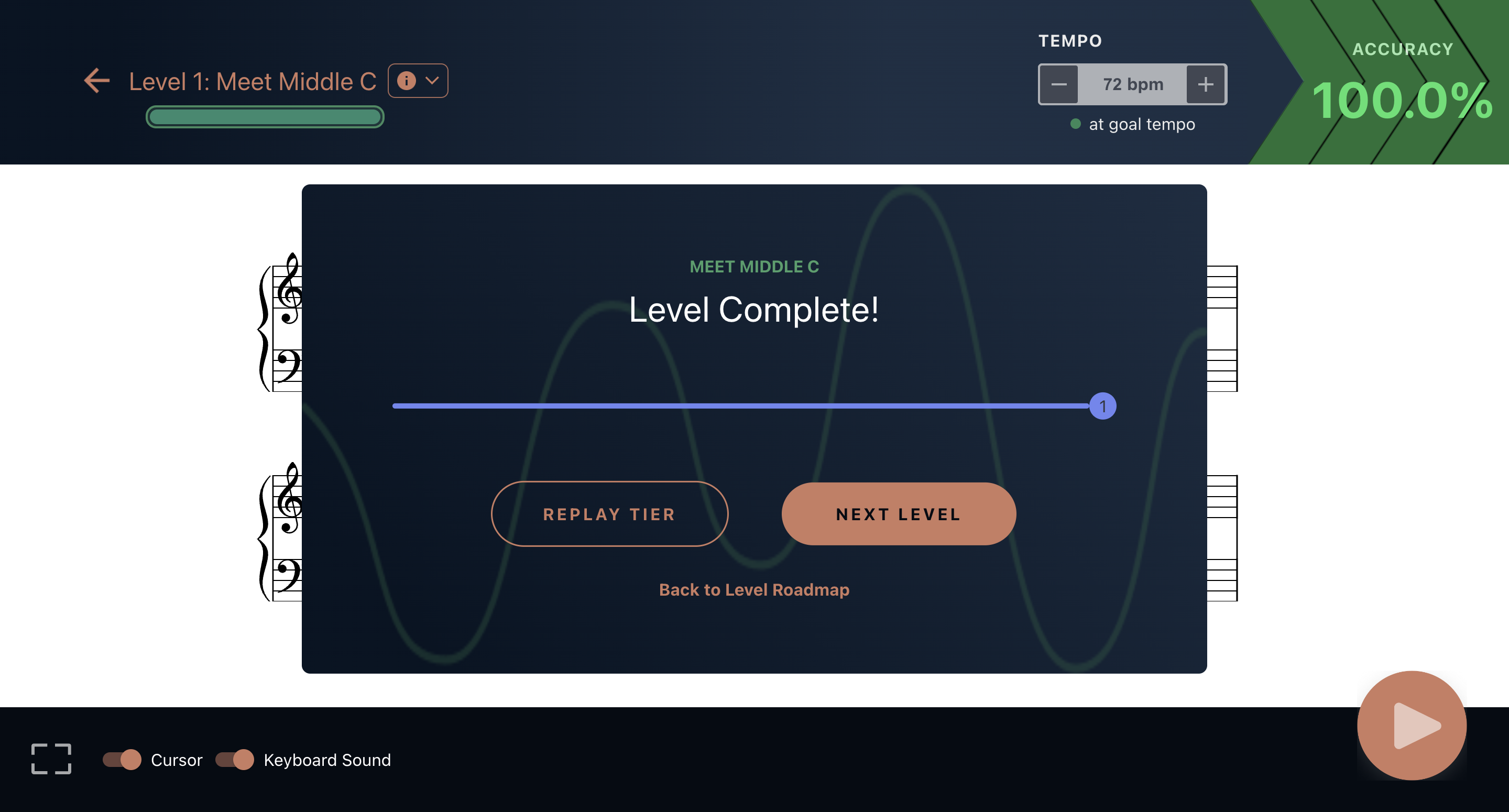
MuseFlow empowers you, no matter where you are in your music learning journey, to reach your music goals by using revolutionary, research and experience backed design to help you overcome common pitfalls.
Let’s talk about the last time you felt anxious, overwhelmed, or sad. Maybe you were grieving the end of a relationship or the loss of a pet. Maybe you were struggling with the change of seasons or shifting family dynamics. These experiences are tough, and it can be hard to cope.
Now let’s think about the tools you used to manage those emotions. Did music play even a small role in helping you feel better?
If it didn’t, it probably could have—because both listening to and playing music can offer comfort when talking alone can’t. Music soothes us when we’re stressed and instills hope when we’re depressed, restless, or simply interested in self-improvement. Piano learning apps could be a solid place to start.
We’ll talk about one of the best piano learning apps shortly. First, let’s discuss the link between music and mental health.

The secret is out, and music can 100% help us regulate our emotions. Before we talk about what that looks like, consider Merriam-Webster’s definition of music:
a: vocal, instrumental, or mechanical sounds having rhythm, melody, or harmony
b: the science or art of ordering tones or sounds in succession, in combination, and in temporal relationships to produce a composition having unity and continuity
The verdict is in, and by definition, music is both an art and a science. It also promotes unity and has a soothing effect on the body. This is because music reaches deep into the endocrine system, which produces the hormones that impact how we feel. So when we play or listen to music, the body triggers the release of dopamine—the feel-good hormone responsible for pleasure and reward.
“I don’t think I’ve ever been this good at reading music. It never made sense to me before.” – Arjuna C., MuseFlow (a piano learning app) student
At the same time, music lowers cortisol, the stress hormone, making us feel calmer and more at ease. It can even improve our immune health by increasing levels of an important antibody, salivary immunoglobulin A, which offers protection from illness. And another study found that playing or listening to music at 60 beats per minute can induce a state of relaxation by driving alpha wave activity. (Alpha waves are associated with wakeful relaxation, which helps the brain unwind and fuels mental clarity.)
It’s no wonder that in therapeutic settings, experts use music to help clients process their emotions. Techniques like guided listening and music improvisation allow people to access their feelings and memories in ways that might be difficult to articulate verbally. From where we’re standing, it makes total sense that 71% of surveyed adults cited music as the greatest influence on their mood. After all, creativity makes us feel good.

Listening to music is powerful—but playing music can have an even greater impact. Learning to play an instrument like the piano is a solid way to get your creative juices flowing. You see, learning new things that are right outside your skill level challenge the brain to think in new ways: finding patterns, making connections, and ultimately achieving a flow state. This helps us break free from linear thinking and fully embrace creative problem-solving.
“Let’s go!! Kept myself in the flow state by first dropping the tempo so it wouldn’t be too frustrating, then got comfortable, then before it became too easy to the point of boring I reattempted it at goal tempo and I passed. What a rush of dopamine from completing the level that initially I couldn’t do!!” – Kyle L., MuseFlow student
From a neuroscience standpoint, learning an instrument like the piano activates several areas of the brain all at once. AI piano teaching apps like MuseFlow, for instance, engage the prefrontal cortex—responsible for planning and decision-making—along with the motor cortex and auditory system. This helps improve emotional regulation and unlocks creativity.
Fortunately, platforms like MuseFlow are making it easier than ever to learn the piano and unlock your full creative potential. Regardless of your skill level, piano training apps will give you space to clear your mind and grow creatively.

Thanks to technology, engaging with music has never been more accessible—or more innovative. Piano practice apps like MuseFlow, recognized as one of the best piano apps of 2026, are transforming how we learn and experience music. These tools let people explore their creativity in ways that traditional methods might not.
For instance, piano lesson apps can guide students step-by-step through learning an instrument, complete with personalized feedback and positive encouragement. This real-time interaction builds confidence and creativity. Then, when. you’ve mastered a skill within this game-like environment, you can apply those skills to songs that get unlocked after you pass each level. not to mention, this approach also supports each user’s mental wellness.
“Any success I achieve is its own reward. Just having moved to the next higher level, I feel good and surprised that it went so quickly. That’s a plus!” – Dennis L., MuseFlow student
And technologies like interactive piano lesson apps break down barriers to access too. With MuseFlow’s intuitive design and seamless user experience, anyone can start learning the piano from the comfort of their home—completely at their own pace. Together, music and technology are making creativity and well-being more accessible than ever.
So why not take the first step toward a healthier, more creative life? Start your seven-day free trial today and learn the piano through personalized sight reading with MuseFlow. You’ll also tap into the creative and therapeutic benefits of music.
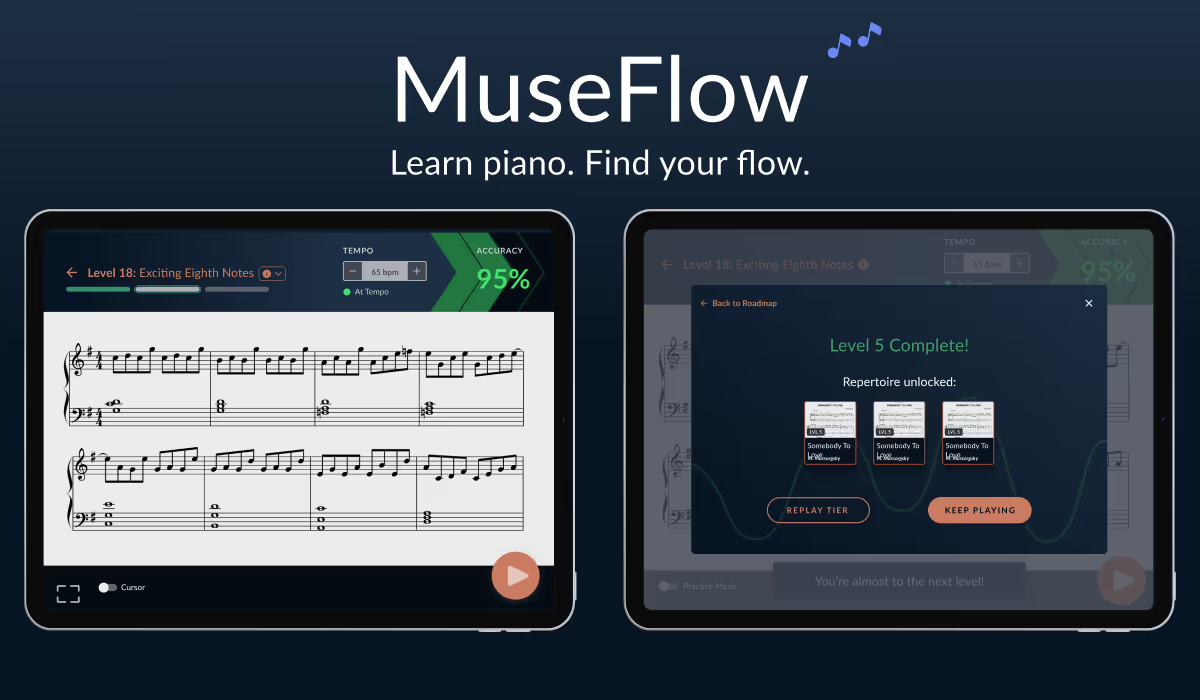

When it comes to the digital music education space, finding the right app will make all the difference in your learning journey. Yousician is a well-known choice, but it might not be the perfect fit for everyone... If you’re searching for the best Yousician alternative, congrats, you have found it! Look no further than MuseFlow. Keep reading to find out why MuseFlow stands out as the best Yousician competitor and also how it will enhance your unique piano learning experience.
Start using MuseFlow today - It's free!
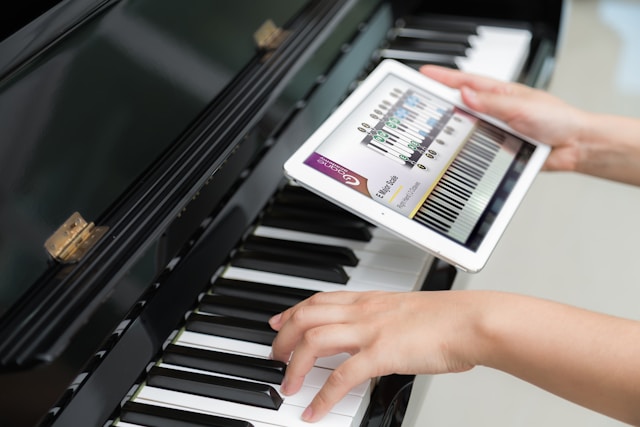
MuseFlow flips the traditional model by making sight reading the core skill... not an afterthought. This approach builds versatile, fluent musicians who can confidently approach any piece of music, not just the few they’ve memorized. Unlike apps that focus on rote repetition or mimicry, MuseFlow trains your brain to understand music in real time, note by note, phrase by phrase.
Why does that matter? Studies show that sight reading correlates strongly with overall musicianship, including better pitch accuracy, rhythmic stability, and musical expression. According to a study published by the International Journal of Music Education, students with strong sight reading skills tend to perform better in all aspects of music learning.
When sight reading is at the heart of the learning process, students engage with a much larger variety of material—boosting fluency, flexibility, and long-term motivation. As noted in this article published on educause.edu, exposure to diverse material and adaptive practice leads to stronger retention and more meaningful learning outcomes.
By mastering sight reading, you’re not just learning songs—you’re learning the language of music.
Wouldn't you love a real-time feedback mechanism? Like a professional expert looking at what you do and nicely giving you advice? Well it's now possible! As you play, the app listens to your performance and then provides instant corrections on notes, timing, and technique, much like a personal tutor! You could even say better than a personal tutor, because it stays friendly and is always available.
Why it matters? Real-time feedback is super critical to correct mistakes right as they happen. This prevents the formation of bad habits and makes sure that you develop the perfect playing techniques. It will save you time in the long run. This feature is especially LOVED by beginners, because they need constant guidance to progress effectively. This immediate feedback is something that sets MuseFlow apart from many Yousician competitors!
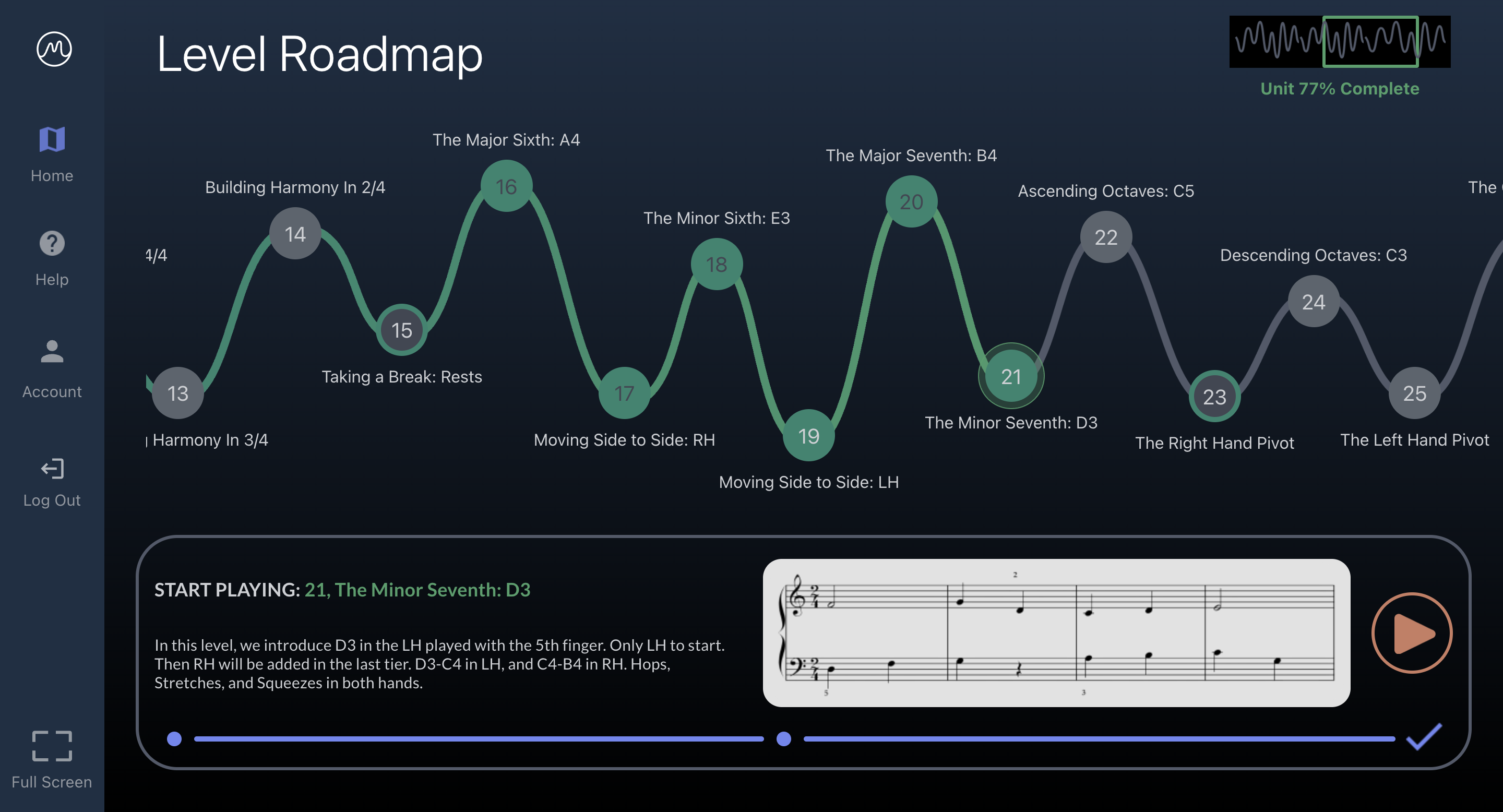
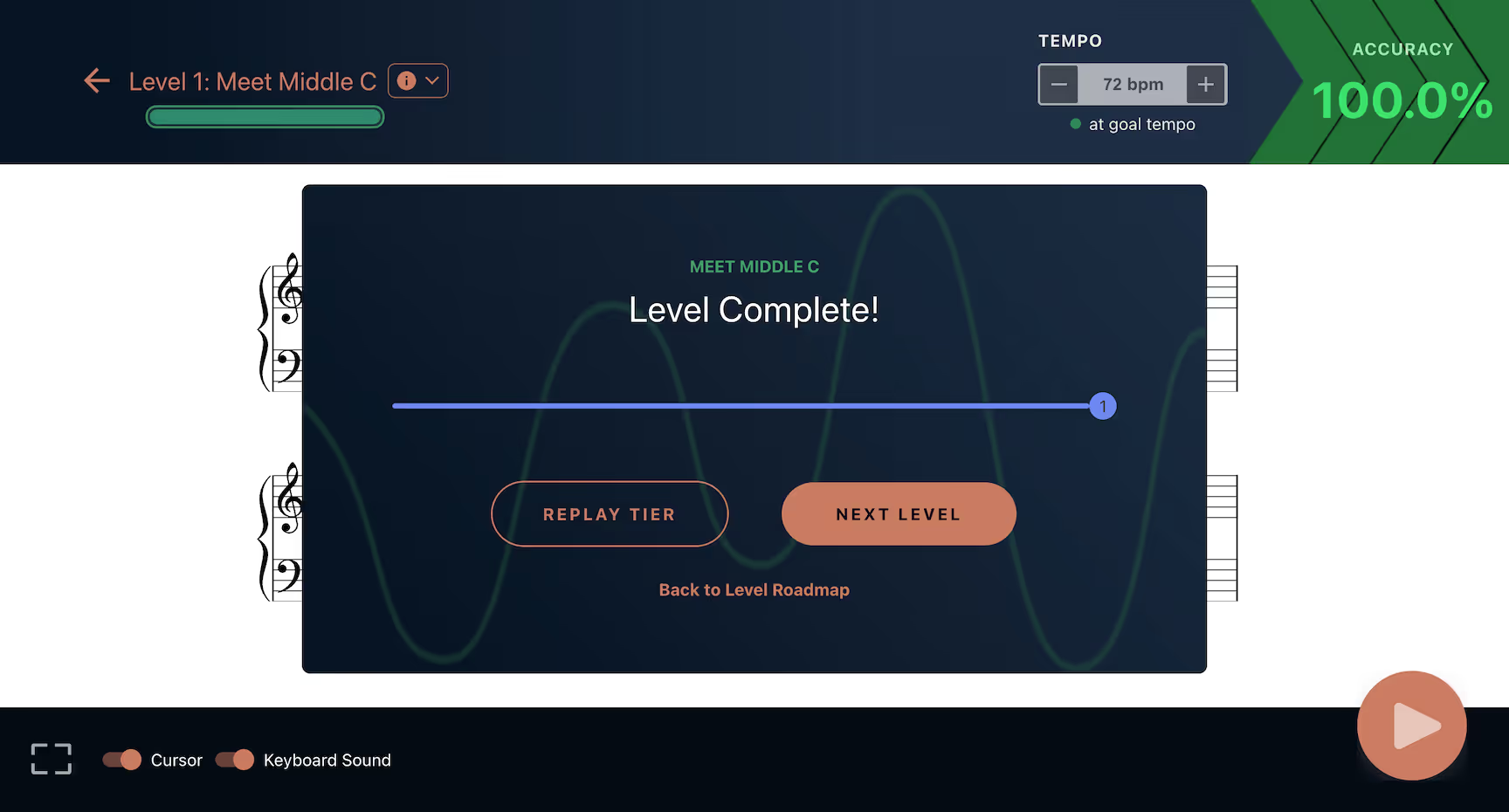
It's the best piano teaching app because it turns learning into an amazing game that you will love playing. This is done through its engaging gamification features. While Yousician offers some vague gamification elements, MuseFlow takes it a lot further. Just look at the pictures below and see. The app makes it a lot more rewarding to practice your skill and provides you with positive reinforcement.
Why it matters? A lot of apps abuse it, but in the correct use-case gamification keeps you motivated & makes learning more enjoyable! The sense of accomplishment from learning a new skill and completing levels boosts your confidence and encourages you to maintain a consistent practice routine. This gamified approach will help you stay committed to your learning journey.
When people look for appl like yousician, MuseFlow always comes up! It offers an all-encompassing learning program that covers all aspects of piano education. From basic techniques to advanced music theory. The app’s extensive curriculum helps you become a more versatile & confident pianist.
Why it matters? A comprehensive educational framework provides a solid foundation for your musical journey! Whether you’re a rookie that just wants to start piano or a pro looking to refine your skills...this innovative new app's thorough curriculum really makes sure that you have access to all the resources you need to succeed!
This is really important for the success of any edtech app. It was developed by professional musicians and educators who deeply understand the challenges of learning piano. They have been through every challenge of learning the instrument. Some of the founders even started as self-taught pianists themselves. This gives them a unique and accurate perspective on the needs and wants of learners like yourself.
Why it matters? You want to learn from people who have done it themselves. They know all your pain points. Learning from this similar app to yousician is designed by experts means you’re getting high-quality instruction. The founders have pride in teaching you to play the piano in the best way possible. It really makes it fun! Additionally with the free trial, it makes it a free alternative.
When trying to find the best Yousician competitor, MuseFlow stands out as the #1. They are loved by their customers and known for their sight reading adaptive learning experience, real-time feedback, unique gamified approach, and expert design. These features make MuseFlow the best choice for ANYONE serious about learning piano.
Join thousands of happy learners who have discovered the benefits of MuseFlow -- see how the app will transform your piano learning journey. We promise you will have fun with this style of learning and also keep staying motivated! This alternative to yousician is the newest and most innovative way to learn and actually ENJOY the learning process.
If you're looking for the best piano learning app, you're in the right place. You've probably come across some apps such as Simply Piano and others. While every technology has some benefits, there is a new player in town that you have to check out. MuseFlow stands out as the best Simply Piano alternative, offering unique features and benefits that make it the superior choice for aspiring pianists. In this blog post, we'll explore why the California based tech company is the best Simply Piano competitor and how it will enhance your piano learning journey.
Start using MuseFlow for free now!
One of the most significant advantages MuseFlow has its personalized learning experience. The software uses advanced AI technology to tailor each lesson to your specific skill level and also to your specific learning pace. This means that the app always adapts. It adapts to your progress, making sure that you're always challenged but never overwhelmed. This keeps you learning fast while having fun.
Why it matters? Personalized learning methods keep you engaged & motivated. This makes the learning process more efficient but also a lot more enjoyable than ever before. Instead of just following a rigid (and often boring) curriculum, with MuseFlow you learn at your own pace, while focusing on areas that need improvement, reinforcing your strengths.
The piano teaching app provides real-time feedback on your playing. This is something that many Simply Piano competitors lack. As you practice, the app listens to your performance and offers instant corrections. Those corrections and improvements are on the unique notes, timing, and techniques. This immediate feedback is obviously very important for developing the correct playing habits. This will help you really make sure that mistakes are corrected on the spot. This instant feedback loop will help you get better at a faster rate than ever before.
Why it matters? Real-time feedback helps you progress faster and with greater accuracy. It’s really like having a personal tutor, that is available 24/7! One that guides you through each practice session. This feature is especially beneficial for beginners who need constant guidance to develop their skills correctly.
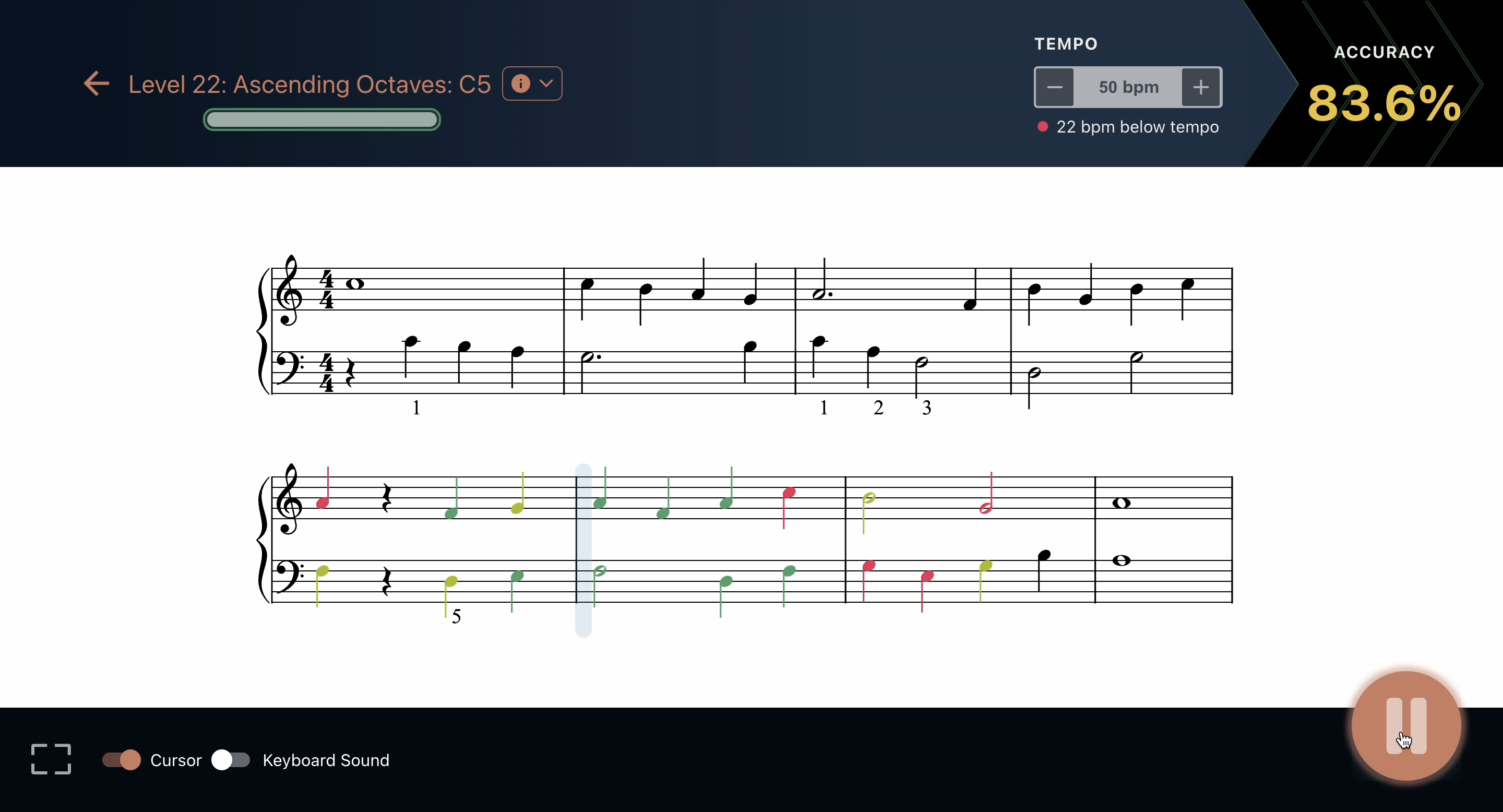
While Simply Piano has some old-school gamification elements, MuseFlow takes it to the next level! The app incorporates fun progress bars, achievement badges, and interactive challenges that make learning piano feel like playing a game. This new gamified approach keeps you motivated and makes practice sessions more enjoyable. You have probably seen it on other apps that keep you engaged, but instead of scrolling an app for no real reason, it's of course better to use it for learning a new skill.
Why it matters? Staying motivated is one of the biggest challenges when learning an instrument. If you've tried learning any instrument, you will completely understand. By making the learning process fun & rewarding, MuseFlow helps you want to stay committed to your practice routine. This helps you achieve your musical goals a lot faster than what was possible before. With our free trial for 7 days, it's like having simply piano free. You will only pay if you like and use the app, you won't get locked in!
MuseFlow offers a thorough educational framework. One that covers all aspects of piano learning, from basic techniques to advanced music theory. The app’s extensive course structure give you well-rounded skill set... making you a more versatile and confident pianist.
Why it matters? You will now have a solid foundation for your musical journey. Whether you’re a complete beginner or looking to refine your skills, MuseFlow’s complete course structure makes sure that you have access to all the resources you need to succeed. You will never get bored!
The piano lessons app was developed by professional musicians and educators. Those who understand the challenges of learning piano. Some of the founders started as self-taught pianists themselves, which gives them a unique perspective on the needs of learners. Their expertise is strongly reflected in the app’s user-friendly design and thoughtful features. We can assure you that you'll really enjoy taking your Midi piano lessons, more than any other lessons, we promise you that!
Why it matters? Learning from an app designed by experts means you’re getting high-quality instruction that addresses the most important challenges & frustrations. This unique design, with you as the user in mind as the #1 priority, ensures that you’re learning effectively and efficiently -- helping you progress faster.
When it comes to finding the best Simply Piano alternative, MuseFlow is your best choice! That's for many reasons, such as its personalized learning experience, real-time feedback, gamified approach, comprehensive curriculum, and expert design. These features make MuseFlow the better choice for anyone serious about learning piano. The app has a free trial, so you can try it before having to pay anything.
While Simply Piano is an option, MuseFlow offers a more tailored and engaging learning experience that can help you achieve your musical goals faster, while bringing more joy into your life.

Keep up to date on our progress as we continue to add new features!